Short answer: yes. Slower, and with more attention to recovery than you needed at 25, but yes.
Why type II fibers are the ones at risk
Muscle isn’t one uniform tissue. Type I (“slow-twitch”) fibers are built for endurance; they fatigue slowly but don’t produce much force. Type II (“fast-twitch”) fibers are built for power; they fire hard and fast but tire quickly. Sprinting, jumping, lifting something heavy, catching yourself when you trip, that’s type II doing the work.
Aging targets type II fibers disproportionately. Past roughly age 40-50, we lose muscle mass overall (sarcopenia), but fast-twitch fibers shrink and drop out faster than slow-twitch ones, and the motor neurons that drive them are more prone to failing. Lower testosterone and growth hormone compound the problem, since both support fast-twitch growth and repair.
The practical result: the “explosive” quality of your muscle, how fast you can produce force, declines faster than raw strength or size. That’s the piece worth training for on purpose.
What actually works
Train heavy. Type II fibers get recruited when a lift is genuinely hard, think 75-90% of your one-rep max for 3-8 reps, or lighter loads pushed close to failure. Easy, comfortable reps mostly train type I fibers and won’t move the needle on fast-twitch tissue.
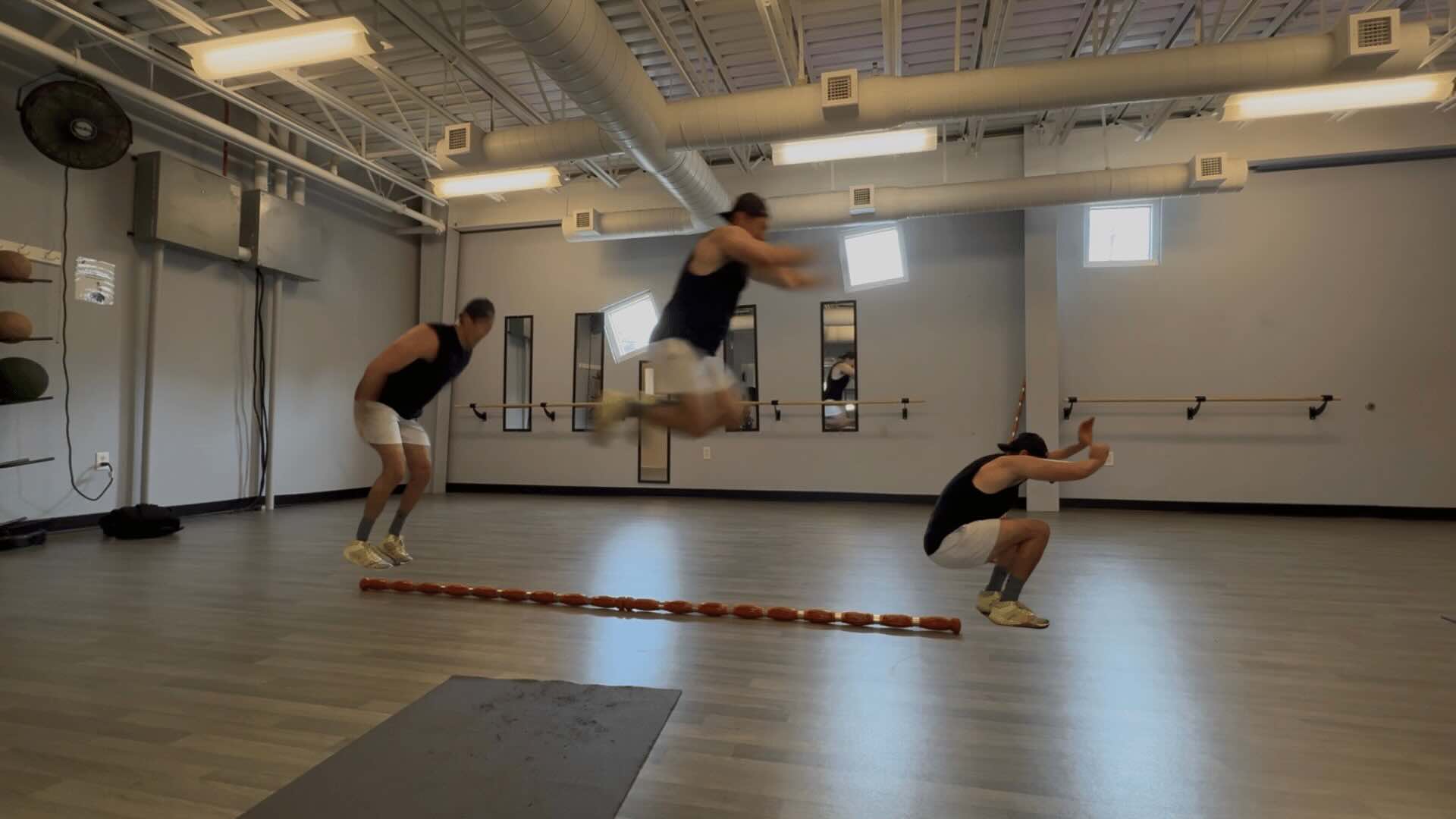
Train explosive. This is the piece most people over 50 quietly drop, usually because it feels riskier than it is. Jump squats, medicine ball throws, sprints, broad jumps, anything that asks the muscle to fire fast, specifically recruits type II fibers. It’s one of the highest-leverage tools you have for preserving power as you age, and it’s the one most programs skip.
Eat enough protein, per meal. Older muscle is less efficient at converting protein into new tissue (“anabolic resistance”), so you generally need more per sitting than you did at 25, research points to roughly 30-40g per meal, to get the same growth signal.
Recover like it matters, because it does. Type II fibers take longer to rebuild after a hard session at 50 than they did at 25. Consistency over months beats occasional max-effort heroics.
The broad jump: your barometer for type II fitness
Here’s the practical problem with all of this: type II fiber quality is invisible day to day. You can’t see it in the mirror the way you can see muscle size, and most people don’t find out theirs has declined until they can’t get up off the floor quickly or they roll an ankle stepping off a curb.
The broad jump (standing long jump) solves that. It’s a clean, honest readout of fast-twitch power because it demands everything type II fibers are good at: rapid force production, full-body coordination, and no time to “muscle through” with slow-twitch endurance. You can’t fake a broad jump with grinding effort, either your fast-twitch system fires, or it doesn’t. And unlike a lot of strength metrics, it takes ten seconds, no equipment, and no gym.
That makes it a rare thing in fitness: a fast-twitch-specific test you can run constantly without it costing you anything in fatigue or time.
Set a number and defend it
The move that makes this stick isn’t just training explosively, it’s picking a measurable target and refusing to let it slide.
My number is 8 feet. That’s the line I’m holding for as long as I can, and I max out my broad jump at the end of every workout to keep it top of mind. It takes one rep, it costs nothing, and it turns an abstract goal (“preserve fast-twitch fibers”) into a concrete one (“don’t let this number drop”).
A few reasons this approach works better than tracking type II fitness in the abstract:
It’s a leading indicator. Broad jump distance tends to drop before you notice power loss anywhere else, catching the trend early gives you time to course-correct with more explosive and heavy work before it compounds.
It’s dead simple to measure. No equipment, no app, no gym required. Mark a line, jump, measure. That’s the whole test.
It builds in the training that protects the number. If your broad jump is dropping, the fix is the same short list above: more heavy work, more explosive work, more protein, more recovery. The test and the training reinforce each other.
If you’re 50 or older and want one thing to track, this is it: pick a broad jump distance you can hold, test it after every workout, and let the number tell you whether your training is actually preserving the fast-twitch muscle you’re trying to keep.
This is general fitness information, not medical advice. Check with a doctor or trainer before starting heavy or explosive training, especially if you’re new to it or have joint or cardiac considerations.
BodyCircuit